
Nobody really knows where consciousness lives.
Neuroscientists can point to networks and electrical activity. They can tell us which regions light up when we remember, love, grieve, or solve a puzzle. But they still cannot point to the place where the simple fact of I am me resides.
That has never bothered me very much.
I’ve always preferred another image.
In my mind, consciousness is a tiny soul-creature wearing a little white cap, carrying a clipboard.
He keeps track of things.
Not because he enjoys it, but because he believes it’s his job.
He remembers where I left my glasses. He reminds me to take my medication. He notices that the cat sounds different today. And, for many years, he faithfully maintained another inventory entirely.
Old hurts.
He catalogued every slight, every betrayal, every disappointment.
Not out of bitterness.
Out of loyalty.
His reasoning was simple:
“Someone hurt us once. I’ll keep the file in case we need it again.”
He was trying to protect me.
Over time, however, I began to realize something.
The warehouse was becoming enormous.
Dusty shelves stretched farther than they needed to.
Boxes were neatly labelled with dates from ten years ago… twenty years ago…
Some of the people involved had probably forgotten the incident before the ink was dry.
Yet my little archivist still carried the files from shelf to shelf, convinced they might one day become important evidence.
One morning I walked into his office.
He looked up from his clipboard.
I placed a paper shredder beside his desk.
Then I said something neither of us had ever considered before.
“Thank you.”
“Thank you for protecting us.”
“You’ve carried these files for years because you thought you had to.”
“But the debt is no longer collectable.”
I stamped each folder:
PAID IN FULL
Not because anyone had apologized.
Not because they deserved absolution.
But because I no longer wished to spend energy collecting a debt that would never be paid.
Some accounts simply expire.
So now my little soul-creature has a new task.
Instead of guarding ancient grievances, he gets to notice chickadees landing on outstretched hands.
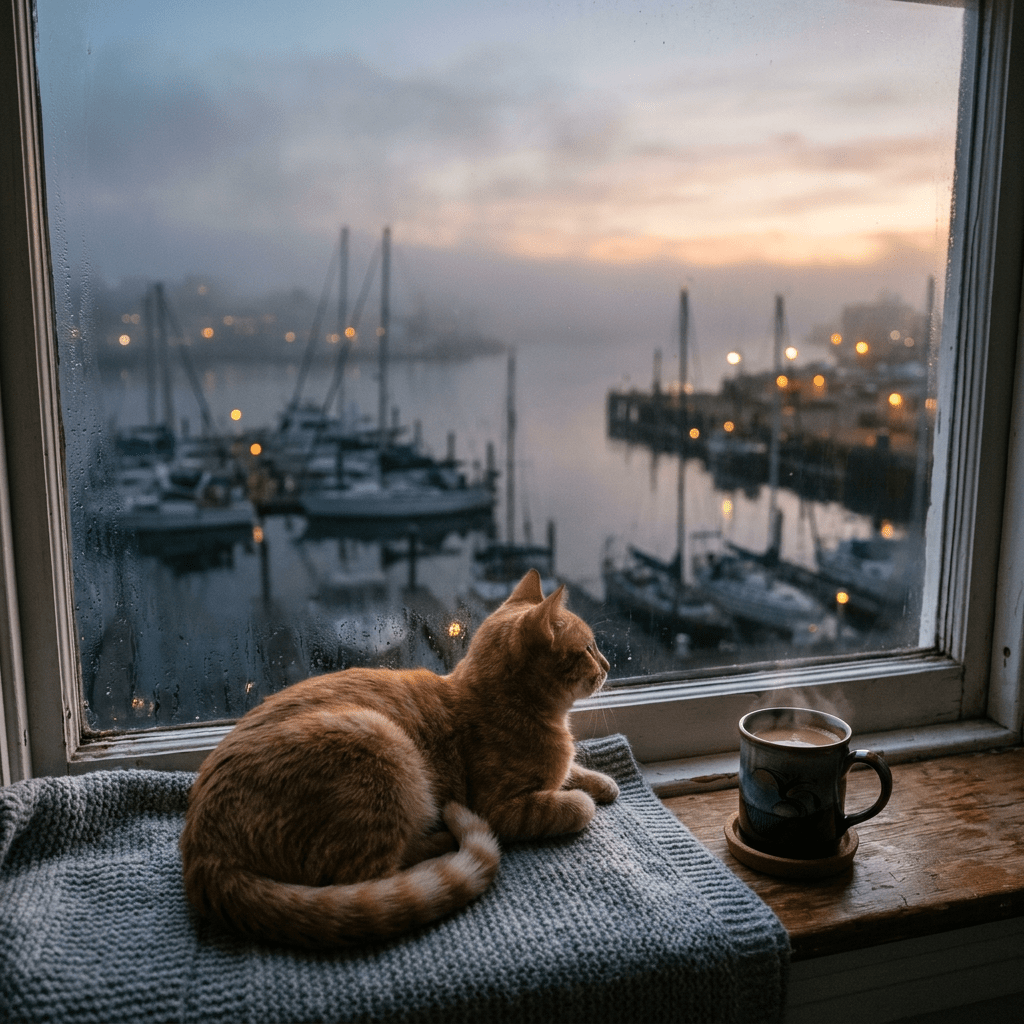
Morning fog lifting from the harbour.
The smell of coffee.
A cat who believes breakfast delayed by thirty seconds constitutes a humanitarian crisis.
There is still plenty to record.
Only now the shelves are lighter.
The warehouse echoes less.
And every so often I hear the soft hum of the shredder.
Not destroying my past.
Simply making room for my life.
 halevai